Willkommen bei RescueHEART
“Saving lives is our priority.”
For us, it's not about sales figures but about sustainable thinking and actions aimed at advancing emergency medicine and life-saving efforts. Saving lives is close to our hearts!
As the general distributor for ViVest Medical, we are actively involved in the fight against sudden cardiac death. In Germany, approximately 65,000 people die from it each year. A rapid and effective rescue chain is vital — especially the immediate start of chest compressions.
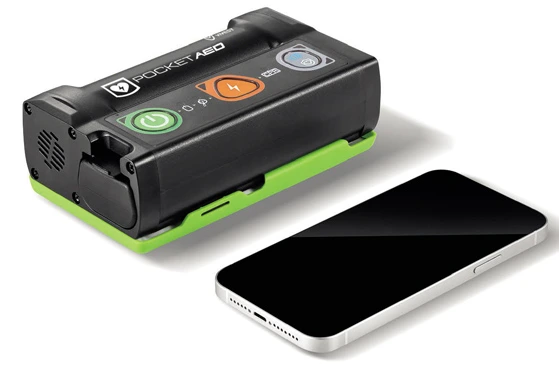
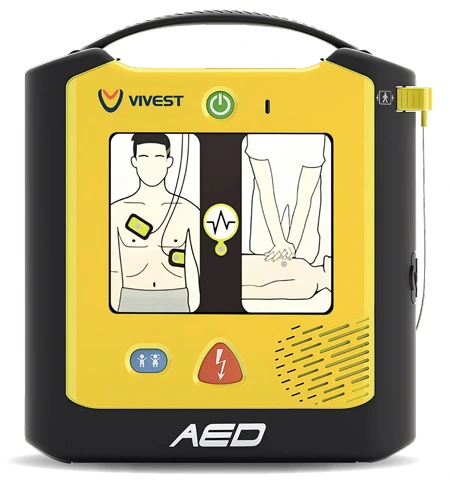
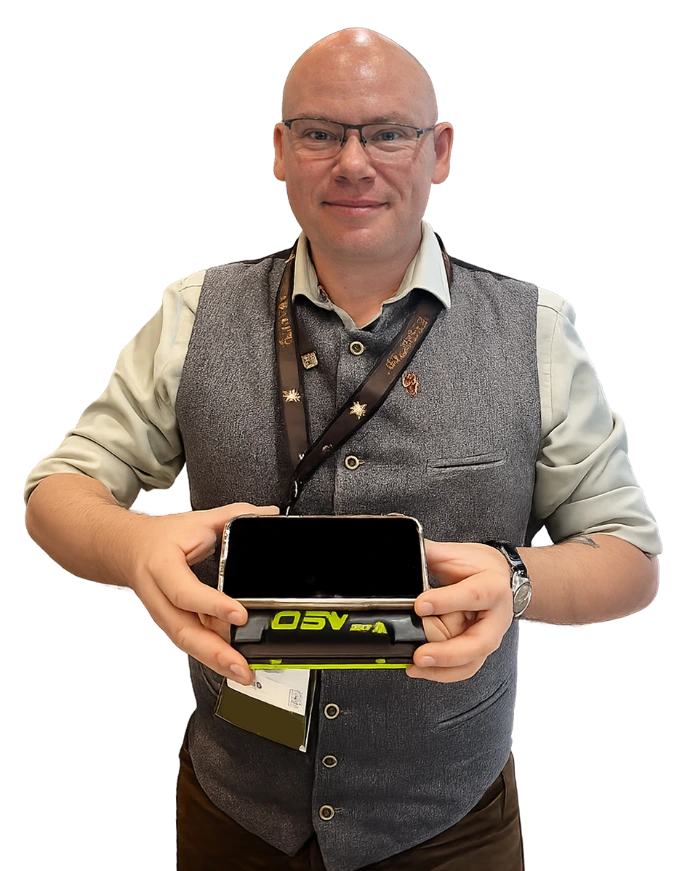
Since ventricular fibrillation and other heart rhythm disturbances are the most common causes, prompt use of an Automated External Defibrillator (AED) by the first responder within the first few minutes is crucial! One of the smallest AEDs in a mobile-phone size finally offers the possibility to carry a fully functional defibrillator for use on adults and children everywhere and at any time.
The aim is to significantly increase the chances of survival (see below "Surviving Sudden Cardiac Arrest").
Products
ViVest AED public defibrillators from ViVest AED A1 or AED A3
We are looking for partners, team members or specialist dealers. Learn more



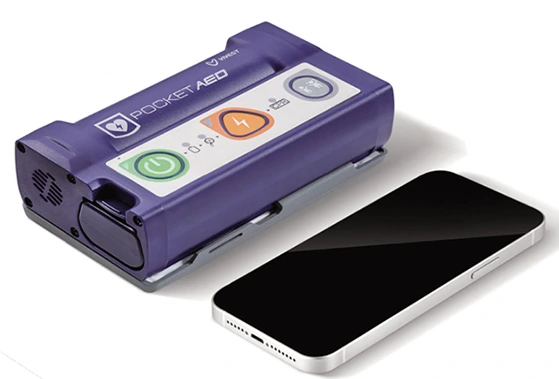
What is an AED (Automated External Defibrillator)?
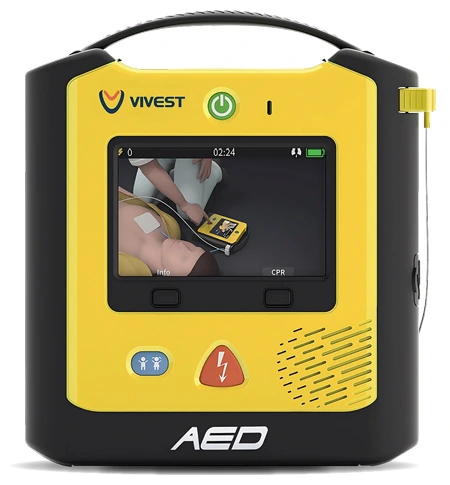
An Automated External Defibrillator is an intelligent medical device specifically designed to terminate life-threatening heart rhythm disorders through targeted electrical shocks.
Here is the step-by-step functionality explained:
1. Rhythm analysis via electrodes
As soon as the electrode pads are attached to the patient's upper body, they function as sensors. The AED derives an electrocardiogram to analyse the heart rhythm (Zhang, Deng and Yin, 2026). The device specifically detects whether a "shockable rhythm" is present, such as:
Ventricular fibrillation: The heart is only twitching uncontrollably and is no longer pumping blood (Masri et al., 2019).
Pulseless ventricular tachycardia: Das Herz schlägt so schnell, dass keine effektive Kreislauffunktion mehr möglich ist (Masri et al., 2019).
2. Automated Decision Making
A crucial aspect of the function is the computer-based analysis. The AED independently decides whether a shock is necessary. If a non-shockable rhythm is present (e.g. asystole/flatline), the device refuses to deliver a shock to avoid unnecessarily harming the patient (Truhlář et al., 2015; Yan et al., 2020). In China, these analysis algorithms are subject to the strictest requirements of Class III for medical devices to exclude erroneous decisions (Li et al., 2023).
3. Defibrillation
When a shockable rhythm is detected, the device charges a capacitor.
Energy Release: The AED delivers a high-energy electrical impulse through the chest wall to the heart (Zhang, Deng and Yin, 2026).
Goal: This electrical shock is intended to depolarise all heart muscle cells simultaneously ("short-circuiting"). This leads to a brief electrical silence, which should allow the heart's natural pacemaker to regain control and establish an orderly rhythm (Magnusson et al., 2020).
4. User Guidance and Safety
As AEDs are designed for laypersons, the function is closely linked to an interactive guide:
Voice instructions: The device acoustically guides the helper through the resuscitation and sets the pace for chest compressions (Hou, Wang and Wang, 2021).
Safety barriers: Modern devices have a protection that ensures that the delivered energy effectively reaches the heart without destroying other medical devices connected to the patient (Zhang, Deng and Yin, 2026).
5. Integration into the rescue chain
After the shock is delivered, the AED usually prompts the rescuer to immediately continue chest compressions until the next analysis is performed (usually after 2 minutes) (Yasunaga et al., 2011; Hou, Wang and Wang, 2021). Studies show that the use of an AED on-site can double the likelihood of neurologically intact survival compared to chest compressions alone (Berdowski et al., 2011).
In summary:
The main function of the AED is not to "restart" the heart, but to stop an electrical chaos so that the heart can find its way back to the correct rhythm.
Survival in sudden cardiac arrest
The likelihood of survival in sudden cardiac arrest heavily depends on whether the incident occurs outside or inside a hospital and how quickly first aid is administered.
1. Global survival rates
The chances of surviving an out-of-hospital cardiac arrest and being discharged alive from the hospital are still low worldwide, but vary significantly by region:
Global average: The survival rate to hospital discharge is approximately 8.8 % (Yan et al., 2020).
Regional differences: While survival rates in North America (~6.8 %) and Europe (~7.6 %) are higher, the rate in Asia averages 3.0 % significantly lower (Lei et al., 2020).
Situation in China: In China, the survival rate for out-of-hospital incidents is historically even at less than 1 % (Yan et al., 2020; Hou, Wang and Wang, 2021).
2. The factor of time: The "Golden Minutes"
The time until defibrillation is the most critical factor for survival. Every minute without treatment reduces the chance of survival by about 7–10 % (Magnusson et al., 2020).
Early intervention: If defibrillation occurs within the first 2 minutes the 1-month survival rate is about 13.2 %. If the response time exceeds 11 minutes, this rate drops to 3.6 % (Yasunaga et al., 2011).
Special scenarios: In controlled environments such as airplanes, where medical personnel and AEDs are immediately available, the survival rate until hospital admission for shockable rhythms can rise to 33–50 % steigen (Truhlář et al., 2015).
3. Factors influencing prognosis
Several factors determine whether a patient survives:
Present bystanders: Performing chest compressions and using an AED by bystanders significantly improves outcomes (Yasunaga et al., 2011; Yan et al., 2020).
Initial Rhythm: Patients with a "shockable" rhythm have significantly better chances of survival than patients with asystole, where defibrillation is not possible (Truhlář et al., 2015; Yan et al., 2020).
AED Availability: The use of an AED available on-site can approximately double the likelihood of neurologically intact survival (Berdowski et al., 2011).
4. Clinical Milestones of Survival
Statistically, while many patients achieve a short-term stabilization, they die in the further course:
Restoration of spontaneous circulation: 29.7 %
Survival until hospital admission: 22.0 %
Survival after one month: 10.7 %
Survival after one year: 7.7 % (Yan et al., 2020)
In summary, it can be said that the survival probability can be significantly increased through the massive expansion of AED networks (as companies like RescueHEART and ViVest promote) and better training of the population in resuscitation (Hou, Wang and Wang, 2021; Li et al., 2023).

